MIT Artificial Intelligence Laboratory (Rodney Brooks) · legged machine
Genghis
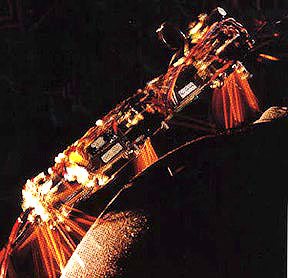
A one-kilogram six-legged insect robot started in 1988 after a NASA JPL workshop on micro-spacecraft. It is now held by the Smithsonian National Air and Space Museum.
- Price
- —Not published
- Height
- —Not published
- Weight
- 1 kgHeavier than 8%
- Payload
- —Not published
- Speed
- —Not published
- Battery
- —Not published
Not sure this is the one? Find the best robot for your job Starts with: research and teaching. Five more quick questions.
Why it matters
Demonstrated Brooks' 'subsumption architecture': insect-like walking emerging from simple layered controllers with no central planner.
Real-world use
None; NASA JPL micro-spacecraft workshop motivated the project
Timeline
- First shown
- 1989
- Released
- Not yet
Maker
MIT Artificial Intelligence Laboratory (Rodney Brooks)University lab · Cambridge, Massachusetts, USAHow it stacks up
Against other legged & novel that publish the figure. Pick a measure.
Genghis is heavier than 8% of the 25 other legged & novel that publish a weight. Bars show the 7 closest in date.
Genghis has more joints than 38% of the 16 other legged & novel that publish a joints. Bars show the 7 closest in date.
Not published by the maker: height, speed, payload, battery, price.
Public attention
A historic robot: no longer sold or in use, so it is not ranked against current machines.
- 496 views of its Wikipedia article in the last 90 days (Genghis (robot))
- No recent press stories listed yet
Measures how much people read and write about a robot, not how good it is. Measured 2026-10-13; same method for every robot. How it is measured
What’s inside
The parts the company has talked about publicly.
- Movement
- Walks on legs · 12 joints
- How it runs
- Fully autonomous. It walked over rough ground using distributed sensor-to-motor control and followed people detected by infrared sensors.
- Actuators & motors
- 12 position-controllable model-airplane servomotors (two per leg); 12 DoF.
- Sensors & vision
- 12 force sensors, six pyroelectric infrared sensors, two inclinometers and two touch whiskers; each leg sensed its own obstacles.
- Compute
- Four on-board 8-bit microprocessors on a 62.5 kbaud token ring; 1 KB RAM and 10 KB EPROM in total.
- Battery & power
- Three silver-zinc batteries.
- AI & software
- Rodney Brooks's subsumption architecture: eight layered behaviours (stand up, walk, force balancing, leg lifting, whiskers, pitch stabilisation, prowling, steered prowling) with no central planner.
- Other details
- About 1 kg and 35 cm long. Now at the Smithsonian National Air and Space Museum.
From the maker
Genghis is the only machine from MIT Artificial Intelligence Laboratory (Rodney Brooks) in the atlas.
Watch Genghis
Made, sold and where
Unit counts are usually company figures; analysts often disagree.
- Price
- Not published
- How to get one
- No official buying page found
- Built
- Research robot (Genghis II followed)
- Sold or delivered
- not sold
- Where it is sold or used
- MIT Artificial Intelligence Laboratory, Cambridge, Massachusetts
- Customers and pilots
- None; NASA JPL micro-spacecraft workshop motivated the project
Sources
Figures come from press coverage. Every link below backs something on this page.
Photos and logos only identify each robot and its maker. Simbeing is not affiliated with, sponsored by or endorsing any company, and nothing here is advertising. Figures are for statistics only and are not advice of any kind. Terms of use