ETH Zurich Robotic Systems Lab · legged machine
HEAP
Hydraulic Excavator for an Autonomous Purpose
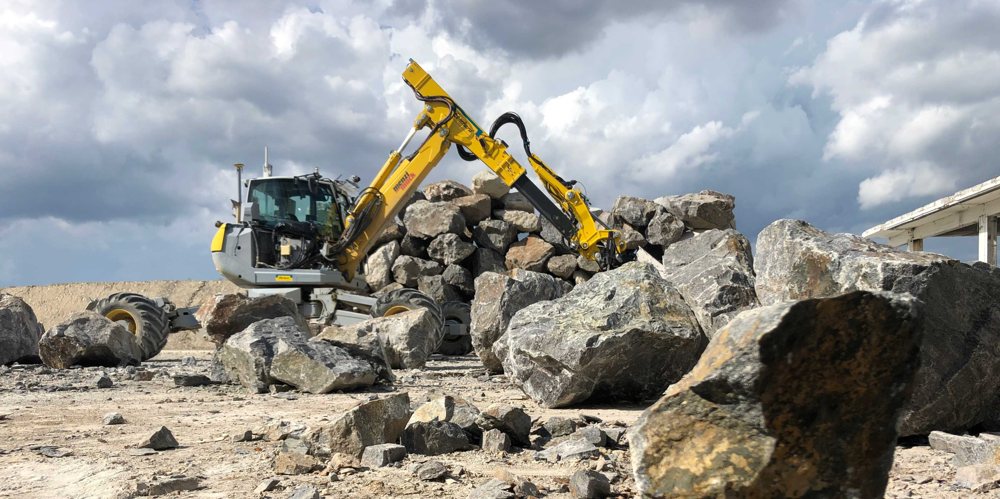
A 12-tonne Menzi Muck walking excavator (four wheeled legs) refitted with GNSS, lidar and force-controlled cylinders so it can dig embankments and stack irregular stones by itself.
- Price
- —Not published
- Height
- —Not published
- Weight
- 12000 kgHeavier than 96%
- Payload
- —Not published
- Speed
- —Not published
- Battery
- —Not published
Not sure this is the one? Find the best robot for your job Starts with: construction. Five more quick questions.
Why it matters
Autonomous walking excavator that built Guinness World Records' largest dry-stone wall made by a robot.
Real-world use
Built a 65 m long, 6 m high wall from boulders and demolition debris at Circularity Park, Oberglatt, Switzerland.
Timeline
- Released
- Not yet
Maker
ETH Zurich Robotic Systems LabUniversity lab · Zurich, SwitzerlandHow it stacks up
Against other legged & novel that publish the figure. Pick a measure.
HEAP (Hydraulic Excavator for an Autonomous Purpose) is heavier than 96% of the 25 other legged & novel that publish a weight. Bars show the 7 closest in date.
Not published by the maker: height, speed, payload, joints, battery, price.
Public attention
How much public attention HEAP (Hydraulic Excavator for an Autonomous Purpose) gets, from open data.
- No Wikipedia article of its own yet
- 2 news stories from reputable press listed on this page
Measures how much people read and write about a robot, not how good it is. Measured 2026-10-13; same method for every robot. How it is measured
What’s inside
The parts the company has talked about publicly.
- Movement
- Wheel-legs
- How it runs
- Fully autonomous. It dug and placed boulders to build a stone wall by itself, with researchers overseeing.
- Actuators & motors
- Menzi Muck M545 12 t walking excavator; all 14 chassis hydraulic cylinders replaced with cylinders with built-in control modules for position and force control
- Hands
- Standard bucket or a two-finger stone grapple with encoder-instrumented cylinders
- Sensors & vision
- Leica iCON iXE3 with two GNSS antennas; Velodyne VLP-16 and Livox MID-70 lidars (one on the boom); FLIR Blackfly and roof RGB cameras; draw-wire encoders
- Compute
- Several on-board computers networked with ROS
- AI & software
- C++ and ROS; lidar mapping, learned image segmentation, grasp planning and geometric wall planning
From the maker
HEAP (Hydraulic Excavator for an Autonomous Purpose) is the only machine from ETH Zurich Robotic Systems Lab (on a Menzi Muck M545) in the atlas.
Watch HEAP (Hydraulic Excavator for an Autonomous Purpose)
Made, sold and where
Unit counts are usually company figures; analysts often disagree.
- Price
- Not published
- How to get one
- No official buying page found
- Built
- Single research machine
- Sold or delivered
- not sold
- Where it is sold or used
- ETH Zurich, Switzerland
- Customers and pilots
- Built a 65.5 m dry-stone wall from 938 elements at Circularity Park, Oberglatt
News
The latest 2, newest first. Summaries are ours; tap through for the original.
- HEAP builds a dry-stone retaining wall
Vision Systems Design described the lidar and camera pipeline HEAP used to build a 65 m wall from reclaimed boulders.
Vision Systems Design - Autonomous walking excavator passes trials
Construction Management reported HEAP digging embankments to a few centimetres and building a 4 m stone wall.
Construction Management
Sources
Figures come from a published paper. Every link below backs something on this page.
Photos and logos only identify each robot and its maker. Simbeing is not affiliated with, sponsored by or endorsing any company, and nothing here is advertising. Figures are for statistics only and are not advice of any kind. Terms of use