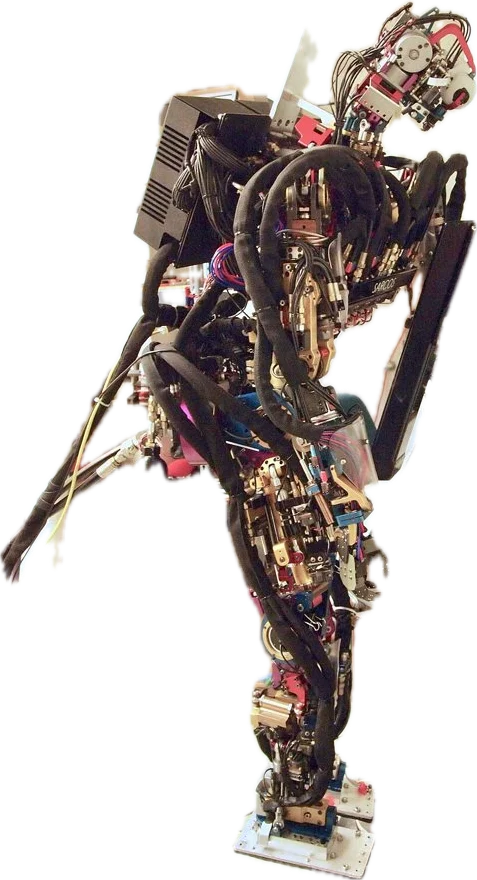
ATR Computational Neuroscience Laboratories and JST ICORP, hardware by SARCOS · research humanoid
CB / CB-i
Computational Brain
A hydraulic full-size humanoid built by SARCOS for ATR's Computational Brain project to study how the brain controls the body, with 1 kHz force control of 50-plus joints; the CB-i version was autonomous. It succeeded SARCOS's earlier DB humanoid for ATR. Height, weight (without battery) and DoF are for CB-i.
- Price
- —Not published
- Height
- 155 cmTaller than 37%
- Weight
- 85 kgHeavier than 77%
- Payload
- —Not published
- Speed
- —Not published
- Battery
- —Not published
Not sure this is the one? Find the best robot for your job Starts with: research and teaching. Five more quick questions.
Why it matters
In January 2008 it walked on a treadmill in Kyoto driven in real time by decoded brain signals from a monkey walking at Duke University in the US.
Real-world use
ATR Computational Neuroscience Laboratories / JST ICORP; collaborators Duke University (Miguel Nicolelis lab) and CMU (Christopher Atkeson)
Timeline
- First shown
- 2006
- Released
- Not yet
Maker
ATR Computational Neuroscience Laboratories and JST ICORP, hardware by SARCOSConsortium · founded 1986 · Keihanna Science City (Kyoto area), JapanCB built under the JST ICORP programme (Japanese government research funding); SARCOS listed on Nasdaq in 2021 and became Palladyne AI (Nasdaq:…
How it stacks up
Against other humanoids that publish the figure. Pick a measure.
CB (Computational Brain) / CB-i is taller than 37% of the 305 other humanoids that publish a height. Bars show the 7 closest in date.
CB (Computational Brain) / CB-i is heavier than 77% of the 277 other humanoids that publish a weight. Bars show the 7 closest in date.
CB (Computational Brain) / CB-i has more joints than 84% of the 236 other humanoids that publish a joints. Bars show the 7 closest in date.
Not published by the maker: speed, payload, battery, price.
Public attention
A historic robot: no longer sold or in use, so it is not ranked against current humanoids.
- No Wikipedia article of its own yet
- 2 news stories from reputable press listed on this page
Measures how much people read and write about a robot, not how good it is. Measured 2026-10-13; same method for every robot. How it is measured
What’s inside
The parts the company has talked about publicly.
- Movement
- Walks on legs · 51 joints
- Actuators & motors
- Joint-level position, velocity and force sensing and control at 1 kHz across about 50 DoF (Advanced Robotics paper); CB-i has 51 DoF with joint angle, velocity, torque and impedance control modes (JST). Hardware built by SARCOS. Actuator type (hydraulic, as stated in the atlas summary) was not confirmed in the pages read.
- Hands
- Five independently controlled fingers per hand for pointing, grasping and gripping; arms are 7 DoF and carry up to 3 kg (JST figures).
- Sensors & vision
- Four video cameras and two microphones in a 7-DoF head; gyro and accelerometer for posture; joint angle, velocity and force feedback at every joint.
- Compute
- Real-time, network-based control architecture covering all joints; in 2008 a stream-based network link carried decoded monkey brain signals from Duke University (US) to the robot at ATR in Japan.
- Battery & power
- CB-i weighs 85 kg without its battery (JST); battery details not published.
- Materials & build
- 155 cm tall; torso flexes and bends sideways like a human's; 7-DoF legs and a yaw waist.
- AI & software
- Dynamic simulator used as a test bed and common interface, with a contact model to validate controllers before hardware tests; biologically inspired central pattern generator walking controller developed with CMU.
- Other details
- Built for the JST ICORP Computational Brain Project (director Mitsuo Kawato, ATR) to test brain models on a full-size body; successor to the DB (Dynamic Brain) robot of the 1996-2001 ERATO Kawato project.
From the maker
CB (Computational Brain) / CB-i is the only humanoid from ATR Computational Neuroscience Laboratories and JST ICORP, hardware by SARCOS in the atlas.
Watch CB (Computational Brain) / CB-i
Made, sold and where
Unit counts are usually company figures; analysts often disagree.
- Price
- Not published
- How to get one
- No official buying page found
- Built
- Not stated (research platform)
- Sold or delivered
- Not sold; research robot
- Where it is sold or used
- SARCOS, Salt Lake City, US (hardware); operated at ATR, Kyoto area, Japan
- Customers and pilots
- ATR Computational Neuroscience Laboratories / JST ICORP; collaborators Duke University (Miguel Nicolelis lab) and CMU (Christopher Atkeson)
News
The latest 2, newest first. Summaries are ours; tap through for the original.
- Monkey brain signals drive CB-i walking in Japan
JST announced that decoded leg-area neural signals from a monkey walking at Duke drove CB-i's legs in Kyoto in real time over the internet.
Japan Science and Technology Agency - CB platform described in Advanced Robotics
Cheng, Hyon, Morimoto, Ude, Hale, Colvin, Scroggin and Jacobsen published the CB design, control architecture and simulator.
Technical University of Munich research portal
Side by side with its peers
Picked by the same rules for every humanoid: another maker’s robot that moves the same way, is at the same stage and does at least one of the same main jobs, first shown within two years. Closer size and price rank higher. How we choose
| Measure | 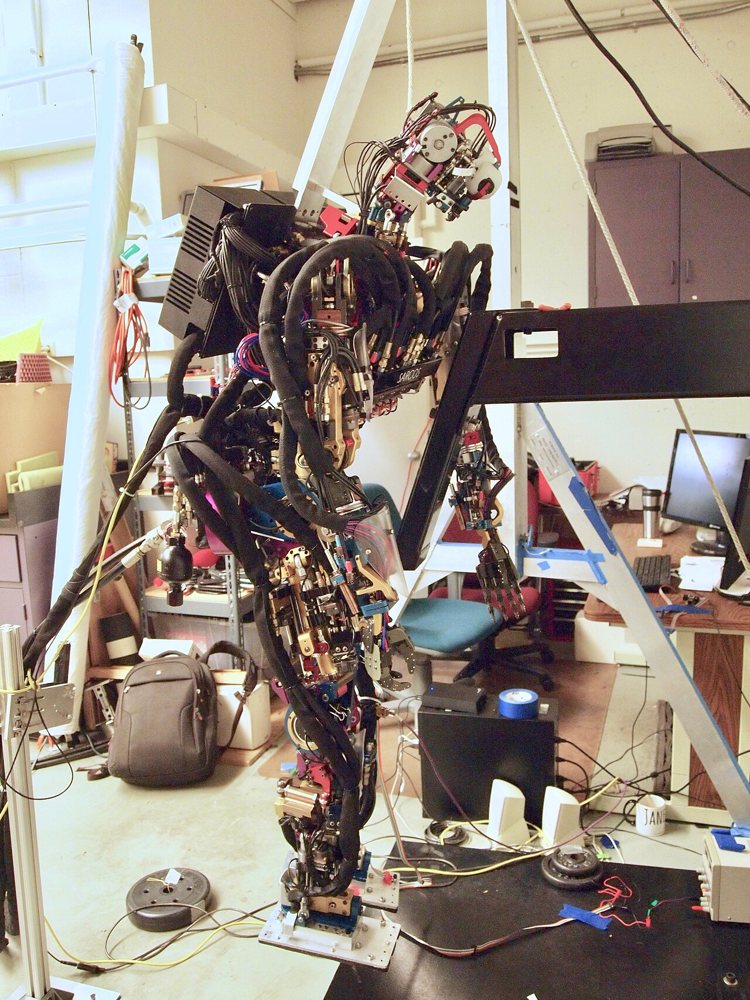 CB (Computational Brain) / CB-iATR Computational Neuroscience Laboratories and JST ICORP, hardware by SARCOS CB (Computational Brain) / CB-iATR Computational Neuroscience Laboratories and JST ICORP, hardware by SARCOS | No public photo yetWe only show photos we're allowed to useBHR-2 (Huitong)Beijing Institute of TechnologySame job: research · Both walk · Both past robots · Similar size | 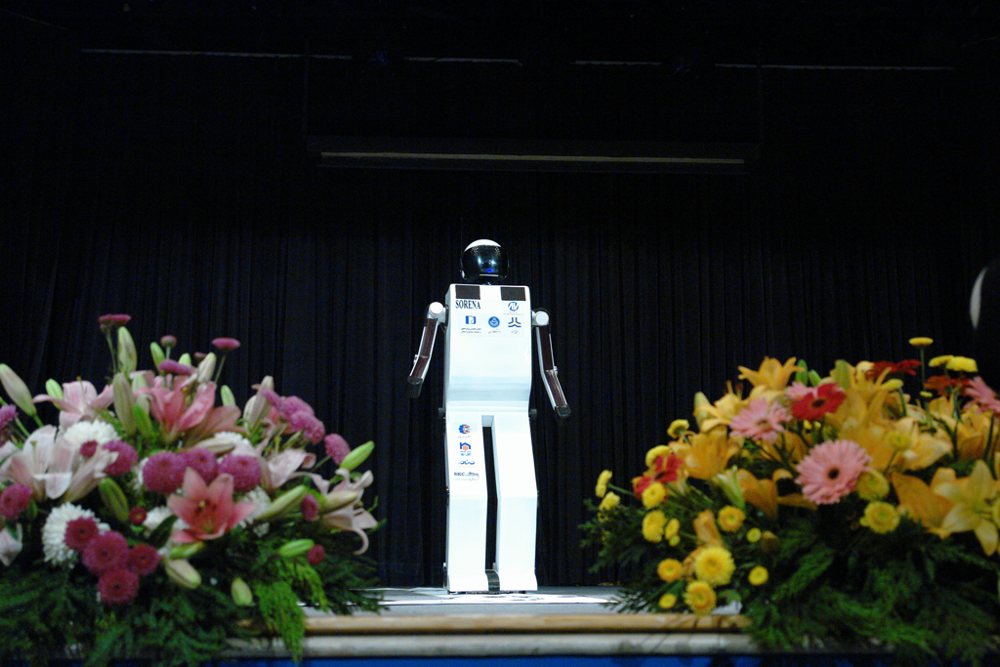 Surena IUniversity of Tehran, Center for Advanced VehiclesSame job: research · Both walk · Both past robots · Similar size Surena IUniversity of Tehran, Center for Advanced VehiclesSame job: research · Both walk · Both past robots · Similar size | 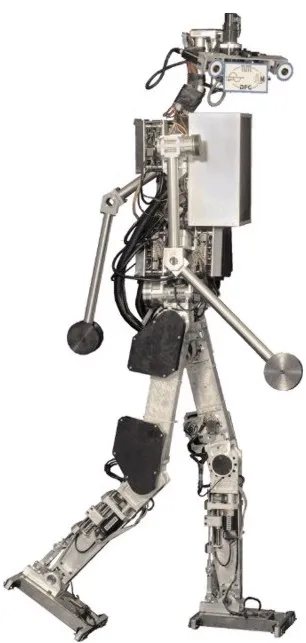 JOHNNIETechnical University of Munich (Institute of Applied Mechanics)Same job: research · Both walk · Both past robots · Similar size JOHNNIETechnical University of Munich (Institute of Applied Mechanics)Same job: research · Both walk · Both past robots · Similar size |
|---|---|---|---|---|
| First shown | 2006 | 2005-09-18 | 2008 | 2003-04 |
| Status | Retired | Retired | Retired | Retired |
| Height | 155 cm | 160 cm | 165 cm | 180 cm |
| Weight | 85 kg | 63 kg | 60 kg | 49 kg |
| Joints | 51 | 32 | 8 | 17 |
| Speed | — | — | — | 2.2 km/h |
| Payload | — | — | — | — |
| Battery | — | — | — | — |
| Price | — | — | — | — |
Sources
Figures come from the maker. Every link below backs something on this page.
Photos and logos only identify each robot and its maker. Simbeing is not affiliated with, sponsored by or endorsing any company, and nothing here is advertising. Figures are for statistics only and are not advice of any kind. Terms of use