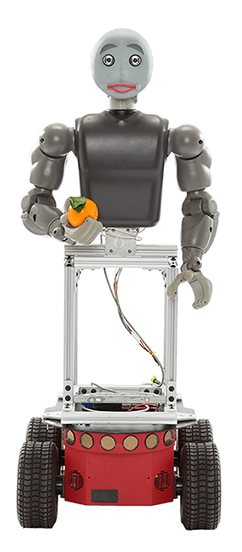
USC Interaction Lab · research humanoid
Bandit
An upper-body social robot with an expressive face, two 7-joint arms and gripper hands, used in research on socially assistive robotics for children with autism, stroke rehabilitation and exercise coaching for older adults. It can sit on a wheeled base for mobility; included despite its 56 cm height because it is a research platform, not a toy.
- Price
- $15,000Cheaper than 65%
- Height
- 56 cmTaller than 2%
- Weight
- 7.7 kgHeavier than 3%
- Payload
- —Not published
- Speed
- —Not published
- Battery
- —Not published
Not sure this is the one? Find the best robot for your job Starts with: greet and guide customers. Five more quick questions.
Why it matters
A research humanoid from USC Interaction Lab and BlueSky Robotics.
Real-world use
USC Interaction Lab studies with children with autism, stroke patients and older adults
Timeline
- First shown
- 2006
- Released
- Not yet
Maker
USC Interaction LabUniversity lab · Los Angeles, California, USAHow it stacks up
Against other humanoids that publish the figure. Pick a measure.
Bandit is taller than 2% of the 305 other humanoids that publish a height. Bars show the 7 closest in date.
Bandit is heavier than 3% of the 277 other humanoids that publish a weight. Bars show the 7 closest in date.
Bandit has more joints than 6% of the 236 other humanoids that publish a joints. Bars show the 7 closest in date.
Bandit costs less than 65% of the 85 other humanoids that publish a price. Bars show the 7 closest in date.
Not published by the maker: speed, payload, battery.
What it has been shown doing
We checked public videos and press for Bandit and found no clear demo of the skills we track yet.
Public attention
How much public attention Bandit gets, from open data.
- No Wikipedia article of its own yet
- 2 news stories from reputable press listed on this page
Measures how much people read and write about a robot, not how good it is. Measured 2026-10-13; same method for every robot. How it is measured
What’s inside
The parts the company has talked about publicly.
- Movement
- Stationary · 19 joints
- Actuators & motors
- 19 DoF in total (7 per arm, 5 in the head), driven by 12 DC motors and seven servos.
- Hands
- Simple gripper hands on two 7-joint arms; IEEE Spectrum (2010) described 6-DoF arms on an earlier configuration.
- Sensors & vision
- Two FireWire cameras in the head as eyes (stereo); a Microsoft Kinect and custom IMUs depending on the study.
- Compute
- Intel Core 2 Duo mini PC on board.
- Battery & power
- Runs from a 12 V, 6 A power supply (tethered power listed; no battery figure).
- Materials & build
- Plastic, aluminium and circuit boards; about 56 cm tall and 7.7 kg for the upper body.
- AI & software
- 64-bit Ubuntu with ROS and custom control software developed in the lab.
- Other details
- Expressive face with movable mouth and eyebrows and a pan-tilt head. Used in socially assistive robotics studies for children with autism, post-stroke rehabilitation and exercise coaching for older adults; it can be mounted on a wheeled base. First prototype 2004, improved 2006-07.
Named suppliers:ROS (Open Robotics)IntelMicrosoft (Kinect)
From the maker
Bandit is the only humanoid from USC Interaction Lab and BlueSky Robotics in the atlas.
Watch Bandit
Made, sold and where
Unit counts are usually company figures; analysts often disagree.
- Price
- $15,000Listed research-unit cost of about USD 15,000; six copies built 2007-2008
- How to get one
- No official buying page found
- Built
- Six copies built in 2007-2008
- Sold or delivered
- Research robot; listed cost about USD 15,000
- Where it is sold or used
- Los Angeles, USA (USC with BlueSky Robotics)
- Customers and pilots
- USC Interaction Lab studies with children with autism, stroke patients and older adults
News
The latest 2, newest first. Summaries are ours; tap through for the original.
- USC shows off Bandit and other lab robots
IEEE Spectrum showed Bandit coaching and encouraging older adults through exercises and noted its use with children with autism.
IEEE Spectrum - Mataric's caregiving robots profiled
A profile of Maja Mataric described Bandit blowing bubbles and mirroring children with autism while logging their behaviour for later analysis.
IEEE Spectrum
Side by side with its peers
Picked by the same rules for every humanoid: another maker’s robot that moves the same way, is at the same stage and does at least one of the same main jobs, first shown within two years. Closer size and price rank higher. Few robots match closely, so these are the nearest matches. How we choose
| Measure | BanditUSC Interaction Lab and BlueSky Robotics | 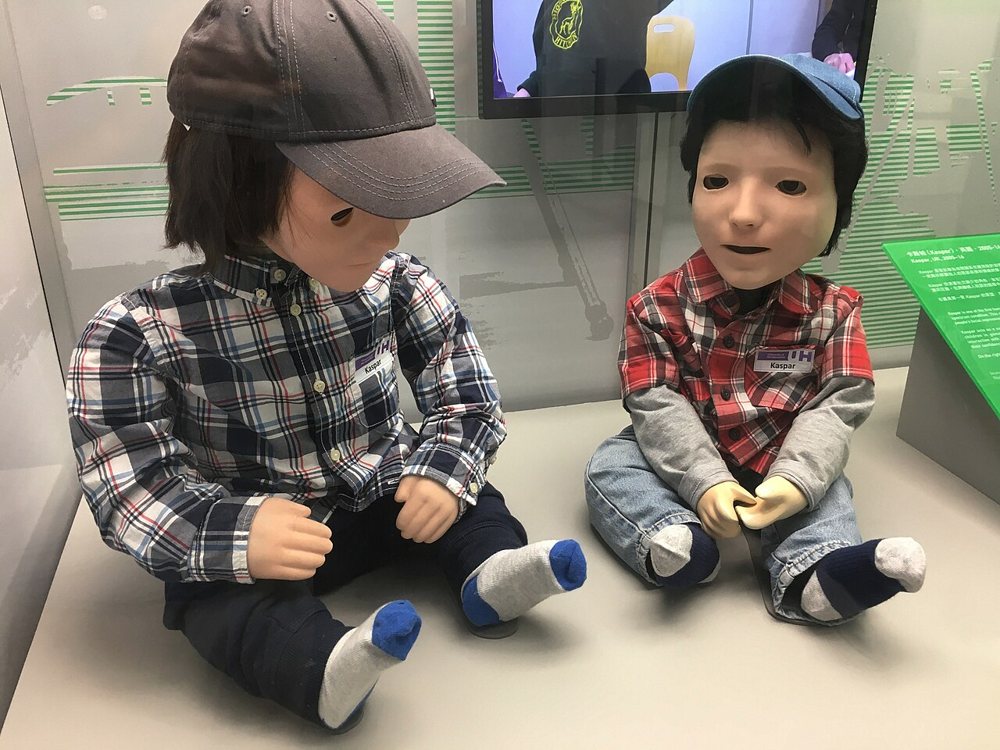 KasparUniversity of HertfordshireSame job: care · Both fixed in place · Both research platforms KasparUniversity of HertfordshireSame job: care · Both fixed in place · Both research platforms |
|---|---|---|
| First shown | 2006 | 2005 |
| Status | Research | Research |
| Height | 56 cm | — |
| Weight | 7.7 kg | — |
| Joints | 19 | 17 |
| Speed | — | — |
| Payload | — | — |
| Battery | — | — |
| Price | $15,000 | — |
Sources
Figures come from press coverage. Every link below backs something on this page.
Photos and logos only identify each robot and its maker. Simbeing is not affiliated with, sponsored by or endorsing any company, and nothing here is advertising. Figures are for statistics only and are not advice of any kind. Terms of use